Last Updated on October 18, 2026 by African Travel Hub Editorial
It’s 5am. The camp is still dark. Someone hands you a cup of coffee, and you climb into a vehicle half asleep, wondering why you agreed to this.
An hour later, you know exactly why.
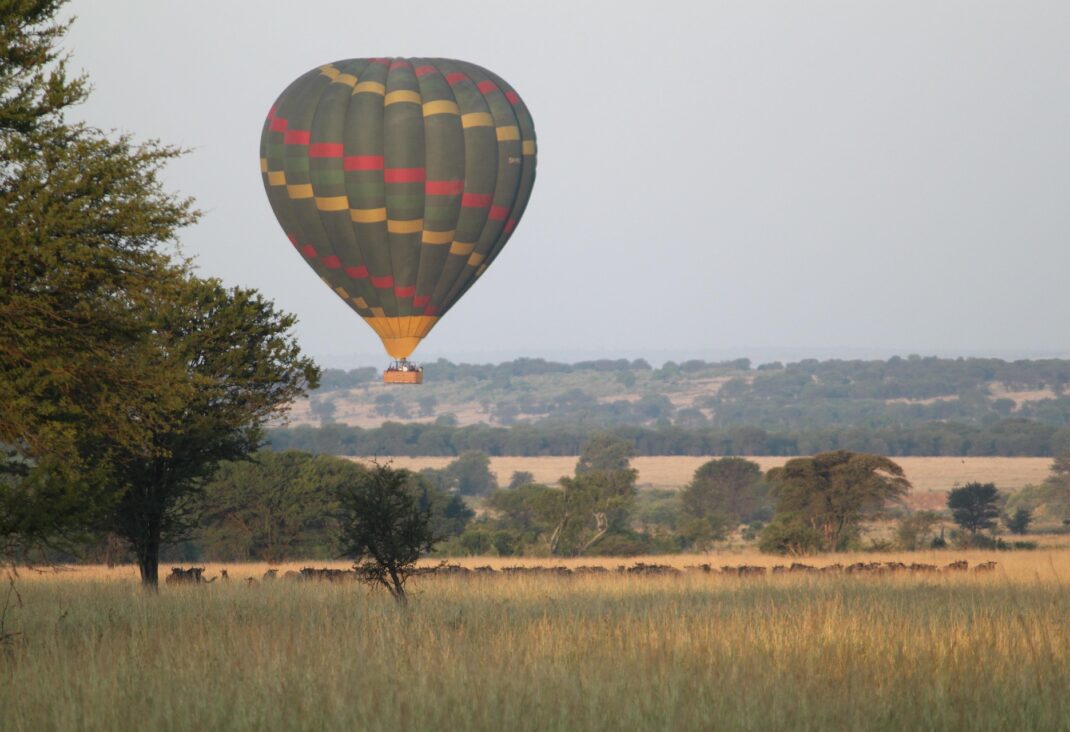
The burner roars. The basket lifts off the ground. And Africa opens up beneath you. Maybe it’s the gold grass of the Serengeti. Maybe it’s the red dunes of the Namib, the waterways of the Okavango or the temples of ancient Thebes on the banks of the Nile. The sun climbs over the horizon, and for a moment nobody in the basket says a word.
Hot air balloon safaris do that to people. They’re quiet, slow and completely different from anything you’ll do on the ground.
They’re also more widely available than most travellers realise. Balloon safari tours now operate in at least nine African countries, from Egypt and Morocco in the north to South Africa in the south. Each one offers a very different view.
This guide covers them all. Where you can fly. When each area operates. What it costs. What to wear. What happens if the weather says no. And whether it’s worth the money.
What Exactly Is a Hot Air Balloon Safari?
Table of Contents
A hot air balloon safari is a sunrise flight over a wildlife area or a striking landscape.
You stand in a large wicker basket with other guests and a licensed pilot. The balloon drifts with the wind. There’s no engine noise, apart from the short bursts of the burner. That silence is part of the magic. Animals below often carry on with their morning as if you aren’t there.
Most flights last 45 minutes to an hour. The full experience, from pickup to return, usually takes three to five hours depending on the location.
In East and Southern Africa, the focus is wildlife and wilderness. In North Africa, it’s history and scenery. Same basket, very different views.
How a Balloon Safari Tour Works: Your Morning, Step by Step
Every operator runs things slightly differently. But most balloon safari tours across Africa follow a similar rhythm.
Early pickup. Expect to be collected from your lodge, camp or hotel well before sunrise. In the Serengeti, that usually means around 5am. No, you won’t regret it.
Safety briefing. At the launch site, the pilot explains how to stand, how to hold on and what to do on landing. Listen carefully. It matters.
Inflation. You’ll watch the crew fill the balloon with cold air first, then heat it with the burner. It’s a spectacle in itself, especially with the sky turning pink behind it.
The flight. Roughly 45 minutes to an hour in the air. The pilot rises and descends with the wind, giving you different views as you go.
Landing. The balloon touches down wherever the wind allows. The ground crew will already be on their way.
Celebration. Many operators follow the flight with a celebratory toast and a breakfast. In the bush, that’s often served out on the plains. Check what’s included in your package before you book.
Return. You’ll be taken back to your lodge or hotel, or joined to a game drive. Most guests are back by mid to late morning with the rest of the day still ahead.
Where Can You Go? Africa’s Hot Air Balloon Safari Destinations
Here’s a quick overview. We go through each country in detail below.
| Country | Where you fly | When | What you’ll see |
| Tanzania | Serengeti, Tarangire, Ruaha | Varies by area | Plains game, the Great Migration, baobabs, rivers |
| Kenya | Masai Mara, Amboseli | Mara year-round | Savannah wildlife, Mara River, Kilimanjaro views |
| Uganda | Queen Elizabeth NP, Murchison Falls NP | Check by park | Savannah, Kazinga Channel, the Victoria Nile |
| Botswana | Okavango Delta, Chobe region | Check with operator | Delta channels, floodplains, island forests |
| Zambia | Busanga Plains, Kafue NP | August to October | Floodplains, lechwe, puku, lions |
| Namibia | Sossusvlei / Namib Desert | Year-round, weather permitting | Red dunes, desert plains, oryx |
| South Africa | Pilanesberg, Magaliesberg, Mabula | Year-round, weather permitting | Volcanic crater, Big Five reserves, mountain valleys |
| Egypt | Luxor (West Bank of the Nile) | Year-round, weather permitting | Valley of the Kings, temples, the Nile |
| Morocco | Marrakech countryside | Year-round, weather permitting | Atlas Mountains, palm groves, Berber villages |
Tanzania: The Serengeti and Beyond
Tanzania is one of Africa’s best-known ballooning destinations. And the Serengeti is the headline act.
The Serengeti
The Serengeti is huge, so balloon flights launch from different areas depending on the time of year. Our partner operator flies from three areas:
| Launch area | When it operates | What to expect |
| Seronera (Central Serengeti) | All year round | Classic plains, rivers and resident wildlife. Reliable in every season. |
| Kogatende (Northern Serengeti) | June to November | Close to the Mara River during the migration months. |
| Ndutu (Southern Serengeti ecosystem) | December to March | Short-grass plains during the calving season. |
Your launch site usually depends on where you’re staying. That’s why it’s worth planning your lodge and your flight together, not separately.
If your heart is set on flying over the migration, talk to us early. The northern and southern seasons are popular, and balloon space is limited.
Tarangire National Park
Tarangire is a newer balloon destination. Serengeti Balloon Safaris made its first flight there in June 2024. The route starts near the Silale Swamp and drifts over the Tarangire river valley, lined with baobab trees. The operator has listed the Tarangire season as June to March.
This is a great option if your safari focuses on Tarangire, Lake Manyara and Ngorongoro, and you’re not heading as far as the Serengeti.
Ruaha National Park
In southern Tanzania, balloon flights also operate over Ruaha National Park. The operator lists the Ruaha season as June to October. Ruaha is remote and far less crowded than the northern circuit, which makes a flight here feel very private.
Kenya: The Masai Mara and Amboseli
The Masai Mara
The Masai Mara is Kenya’s classic balloon safari destination. It’s also one of the most famous in the world.
Flights run year-round over the Mara’s open grasslands, with the Mara River snaking below. The Great Migration months, roughly July to October, are the most popular and the most in demand. If you’re travelling then, book your flight when you book your camp.
Several balloon companies operate in the Mara, and flights launch from different areas of the reserve. Your camp’s location affects which operator and launch site you use. We’ll match the two for you.
Amboseli National Park
Some camps around Amboseli offer balloon flights as an optional extra. The draw here is obvious. On a clear morning, you float over elephant herds with Mount Kilimanjaro rising behind them.
Amboseli ballooning is smaller and less established than in the Mara. We’ll confirm the current operator and availability for your dates before adding it to your itinerary.
Uganda: Queen Elizabeth and Murchison Falls
Many travellers are surprised to learn Uganda offers balloon safaris. It does, in two parks.
Queen Elizabeth National Park
Flights launch from the Kasenyi area of the park, early in the morning. You’ll see open savannah, and on a clear day, the lakes and the landscape of the Rift Valley.
Murchison Falls National Park
Uganda’s largest national park offers flights over savannah dotted with giraffe, elephant and Uganda kob, with views towards the Victoria Nile and Lake Albert.
Uganda’s balloon operations are smaller than Tanzania’s or Kenya’s, with limited balloons and seats. Seasons and schedules differ between the two parks. Book well ahead, especially if you’re pairing your balloon flight with gorilla trekking.
Botswana: The Okavango Delta
Okavango Delta
Seeing the Okavango Delta from the air is something special. Channels wind through the floodplains. Islands of forest dot the water. Hippos gather in the pools.
AirVentures lists itself as the sole licensed hot air balloon operator over the Okavango Delta, flying over the remote north-western part. Flights last about 45 minutes and finish with a sparkling wine celebration and a light breakfast in the bush.
Because the area is so remote, you’ll need to stay at least one night at one of the camps in or near the flying concession. We can plan that for you.
Chobe Region
The same operator also lists balloon flights over the Seloko Plains in the Chobe region, an area of forest opening onto grassland plains. Ask us to confirm current availability.
Zambia: The Busanga Plains of Kafue
The Busanga Plains sit in the far north of Kafue National Park, one of Africa’s largest parks. Few travellers make it here. That’s part of the appeal.
Balloon flights operate from August to October, when the floodplains dry out. You float over grassland islands, water channels and big herds of red lechwe and puku. Busanga is also famous for its lions.
The season is short and the camps are small. If Busanga is on your list, start planning early.
Namibia: Sossusvlei and the Namib Desert
This is ballooning at its most surreal.
Instead of savannah, you drift over towering red dunes, gravel plains and desert mountains in one of the oldest deserts on Earth. You may spot oryx, springbok or ostrich moving across the sand below.
Namib Sky Balloon Safaris operates flights in the Sossusvlei area. The flight is about an hour, followed by breakfast in the desert. Transfers and park fees are included in the published rate.
Flights run year-round, weather permitting. Sunrise light on the dunes is extraordinary, so bring a camera with plenty of memory.
South Africa: Pilanesberg, Magaliesberg and Mabula
South Africa offers several balloon options, and some are within easy reach of Johannesburg.
Pilanesberg National Park
Pilanesberg lies in the crater of an ancient extinct volcano in North West Province, next to Sun City. From the balloon, you can clearly see the park’s ring-shaped geology. Below, look for elephant, buffalo, antelope and, with luck, rhino or lion. Flights last about an hour, with sparkling wine and breakfast afterwards. The total experience takes around five hours.
Magaliesberg and the Cradle of Humankind
About an hour’s drive from Johannesburg, balloons fly over the Magalies River Valley and the Cradle of Humankind World Heritage Site. This is more scenic than wildlife-focused. It’s ideal if you have a free morning in Johannesburg before or after your safari.
Bill Harrop’s “Original” Balloon Safaris has operated here since 1981. Its flights depart just after sunrise and include a champagne breakfast.
Mabula Private Game Reserve
The same operator also flies over Mabula Private Game Reserve in Limpopo, a Big Five reserve. This option combines a South Africa safari with ballooning.
Egypt: Luxor and the Valley of the Kings
Egypt’s balloon flights aren’t wildlife safaris. They’re history from the sky.
Flights launch from the West Bank of the Nile at Luxor around sunrise. You float over the Valley of the Kings, the Temple of Hatshepsut and the green fields along the river, with desert cliffs behind. Flights typically last 45 minutes to an hour.
Luxor is one of the most affordable places in Africa to fly. It’s a wonderful add-on if you’re combining an Egypt trip with an East African safari.
Morocco: Marrakech and the Atlas Mountains
Balloon flights also operate from the countryside outside Marrakech.
You drift over palm groves, dry plains and Berber villages, with the Atlas Mountains on the horizon. Flights usually last 40 minutes to an hour and are often followed by a traditional breakfast in a Berber tent.
Like Luxor, this is about landscape and culture rather than wildlife. It’s a great way to start a Moroccan holiday.
Which Balloon Safari Destination Is Right for You?
A quick guide:
- For the Great Migration: the Masai Mara (roughly July to October), or the Serengeti at Kogatende (June to November) or Ndutu (December to March).
- For year-round reliability: Seronera in the Central Serengeti, or the Masai Mara.
- For something remote and quiet: Busanga Plains in Zambia, Ruaha in Tanzania or the Okavango Delta.
- For pure landscape photography: Sossusvlei in Namibia.
- For a gorilla trek combination: Queen Elizabeth or Murchison Falls in Uganda.
- For history and culture: Luxor in Egypt or Marrakech in Morocco.
- For a short add-on from Johannesburg: the Magaliesberg or Pilanesberg.
How High Does the Balloon Fly?
Flight height depends on the location, wind speed and direction, and local aviation rules.
In Tanzania, balloons typically fly at around 3,000 feet. The Tanzania Civil Aviation Authority (TCAA) sets the upper limit at 6,000 feet.
Elsewhere, limits are set by each country’s aviation authority. Your pilot controls altitude throughout the flight and adjusts it to give you the best views while staying well within safety limits. Pilots often drop lower at times for a closer look.
If you’re nervous about heights, here’s what most first-timers say. It doesn’t feel like standing on a ledge. The basket is deep, the movement is gentle and the views pull your attention away from the drop.
Will You See Wildlife From the Balloon?
Honest answer: maybe.
Wildlife sightings on hot air balloon safaris cannot be guaranteed anywhere. What you see depends on animal movements, the season, the habitat you fly over and visibility that morning.
Some guests float over lions, elephants and herds of wildebeest. Others see mostly landscape with a few giraffes and hippos dotted below.
But a balloon safari isn’t really a game drive in the sky. It’s about perspective. From above, you see how the land fits together. The rivers. The kopjes. The animal trails cut into the grass. You understand why these ecosystems are so special.
Your game drives will get you close to the animals. The balloon shows you their world.
What to Wear on a Balloon Safari
Keep it simple and practical.
- Comfortable outdoor clothing in neutral colours. Think safari wear, not evening wear.
- Closed shoes with a good grip. Launch and landing sites are on uneven ground, and you may walk through grass, sand or rough terrain.
- A light jacket, fleece or warm layer. Early mornings can be surprisingly chilly, especially in the Serengeti, the Namib Desert and the Southern African winter. You’ll warm up as the sun rises, so layers work best.
- A hat. It helps with the morning sun and the heat from the burner overhead.
Skip anything loose and floaty, like long scarves. Leave sandals and heels at the lodge.
What to Bring on the Flight (and What to Leave Behind)
A few small items make the experience better:
- A camera. Sunrise from a balloon is a once-in-a-lifetime shot. Charge your battery and clear your memory card.
- Great for spotting animals far below or in the distance.
- The sunrise gets bright fast.
- A hat. As above.
Keep personal belongings to a minimum. Space in the basket is shared, and loose items can be a hazard. Big bags, tripods and bulky gear usually aren’t practical.
Your safety team will tell you what can and can’t come into the basket. Please follow their guidance on the day. They know the aircraft, and they know the conditions.
Where Does the Balloon Land?
There’s no fixed landing spot. That surprises a lot of people.
Balloons go where the wind takes them. The landing location depends on wind conditions and the flight path that morning. Your pilot picks a safe, open area as the flight comes to an end.
Meanwhile, the ground crew follows the balloon. By the time you touch down, they’re usually already there or close behind. They handle the post-landing arrangements, including your transfer to breakfast and back to your lodge, camp or hotel.
Landings are often gentle. Sometimes the basket tips onto its side and slides a little. That’s normal, and the pilot will brief you on exactly how to brace before you take off.
Can You Book a Private Balloon Safari?
Yes, in many places.
Private or exclusive flights may be available, depending on the date and the operator. They’re popular with honeymooners, families and couples celebrating something special. You share the basket only with your own group and the pilot.
Private balloon safari tours cost more than shared flights, and availability is limited. If you’re interested, ask us early. We’ll request availability and pricing from the balloon operator for your dates.
Is a Balloon Safari Suitable for Guests With Mobility Limitations?
It depends on the individual guest and the safety requirements of the flight.
Getting into the basket often involves climbing over the side. Landings can involve a bump. You need to be able to stand for the length of the flight and hold a brace position for a short time. Operators may also have age rules for children.
If you or anyone in your group has mobility concerns, tell us before you book. We’ll discuss your needs with the balloon operator’s reservation team. That way, you get a clear answer before you commit, not on the morning of the flight.
What Happens If the Flight Can’t Go Ahead?
Ballooning depends on the weather. Safety always comes first.
If the flight can’t operate on your booked day, the balloon team will advise on the options available under their operating and booking policies. Depending on the circumstances and the terms, these may include:
- Rescheduling to another morning
- A refund
- Another arrangement
Policies differ between operators and countries. We’ll explain the cancellation and refund policy for your specific flight clearly before you book. Please read it. It’s the best way to avoid surprises.
Our tip: if you can, book your balloon flight for your first or second morning in the area, not your last. It leaves room to reschedule if the weather doesn’t cooperate.
Changed Your Lodge After Booking? Let Us Know Quickly
Plans change. That’s fine. But a balloon flight runs on tight early-morning logistics.
If you switch lodges or camps after your flight is booked, tell us as soon as possible. A change of accommodation can affect your collection point, your transfer arrangements and your pickup time. In some areas, it can even change which launch site or operator you fly with.
We’ll pass the update to the balloon operator’s reservations team and reconfirm everything before your flight. Nobody wants to be waiting at the wrong camp at 5am.
How Much Do Hot Air Balloon Safaris Cost in Africa?
Prices vary a lot by country. Here’s a guide based on rates published by operators and their agents. Always confirm the current price for your dates.
| Destination | Indicative price per person | Notes |
| Serengeti, Tanzania | Around US$599 | Shared flight, 2026 published rate |
| Tarangire, Tanzania | Around US$550 | Launch rate, including park ballooning fee and VAT |
| Masai Mara, Kenya | Around US$550 to US$600 | Shared flight; varies by operator |
| Amboseli, Kenya | Around US$500 to US$550 | Confirm availability first |
| Uganda | Around US$380 | Commonly quoted rate; confirm current price |
| Sossusvlei, Namibia | N$10,720 (roughly US$600) | Published rate, July 2026 to June 2027, includes transfers and park fees |
| Pilanesberg, South Africa | R6,592 plus R748 park fee | International rate, valid to 30 November 2026 |
| Magaliesberg, South Africa | From around R2,600 | Depends on flight and extras |
| Luxor, Egypt | Around US$70 to US$150 | Varies by operator, timing and booking channel |
| Marrakech, Morocco | Around €100 to €180 | Varies by operator and package |
We don’t have a reliable current published rate for Okavango, Chobe, Busanga or Ruaha flights. Ask us and we’ll get a firm quote.
Private flights, special occasions and peak-season dates usually cost more. When you compare quotes, check exactly what’s included:
- Pickup and drop-off from your lodge or hotel
- The flight itself
- The toast and breakfast
- Taxes
- Any park or conservation fees
A cheaper quote that leaves out transfers or breakfast isn’t always cheaper.
Book early. Balloon space is limited almost everywhere, especially in migration season and in smaller operations like Uganda and Busanga. We recommend confirming your flight as soon as your lodge dates are set.
Are Hot Air Balloon Safaris Worth It?
It’s a fair question. Several hundred dollars is a lot of money for a morning.
Here’s how we’d put it. If you’re on a tight budget, an extra day of game drives might give you more wildlife for your money. That’s a perfectly good choice.
But if you want a moment that stays with you, the balloon is hard to beat. Guests rarely remember every game drive. They almost always remember the silence of the basket, the sun coming up over the land and the first sight of a herd moving below.
It’s also a great option for:
- Honeymooners and couples marking a milestone
- Photographers chasing a different angle
- Repeat safari travellers looking for something new
- Anyone who wants to understand a landscape, not just see it
Planning Your Balloon Safari Tour
A balloon flight works best when it fits naturally into your wider itinerary. The right country, the right lodge, the right season and the right morning all make a difference.
If you’re thinking about adding a hot air balloon safari to your trip, we’re happy to help you work it in. Tell us where you’d like to go, your travel dates and what you’d most love to see. We’ll check availability and give you honest advice on whether it suits your plans.
No pressure. Just good planning, so your sunrise over Africa goes exactly the way you imagined.
About the Author