
Last Updated on April 22, 2026 by African Travel Hub Editorial
Ethiopia Tours 2026-2027
Africa’s Most Historically Rich Destination
Ethiopia is the only country in Africa never to have been colonised, home to 12 UNESCO World Heritage Sites, and the literal cradle of humankind — making it one of the most extraordinary travel destinations on earth.
From 3.2-million-year-old fossils to still-active lava lakes, medieval rock-hewn churches to one of the world’s most ethnically diverse valleys, Ethiopia delivers an unmatched depth of experience for the curious traveller. This page covers every major destination, touring style, practical logistics, and insider planning detail you need to plan a memorable Ethiopia trip.
What Makes Ethiopia Different from Every Other African Destination
Ethiopia stands apart from its neighbours — and from most countries in the world — on several counts:
- Unique calendar and clock: Ethiopia uses the Coptic calendar, which is roughly 7–8 years behind the Gregorian calendar. New Year falls on 11 September. The Ethiopian clock begins at 6:00 AM, meaning 7 AM local clock = 1 o’clock in Ethiopia. Travellers should confirm all meeting times carefully.
- Never colonised: Ethiopia defeated Italian forces at the Battle of Adwa in 1896, making it a powerful symbol of African independence and pride. This history permeates the culture, architecture, and national identity in ways unlike anywhere else on the continent.
- Oldest written script still in daily use: Ge’ez (Ethiopic) script, used in Amharic and Tigrinya, is one of the world’s oldest active writing systems.
- The origin of coffee: Ethiopia is the birthplace of Coffea arabica. The traditional coffee ceremony — roasting, grinding, and brewing fresh beans — is a cornerstone of social life. The Gedeo Cultural Landscape, inscribed as a UNESCO World Heritage Site in 2023, celebrates this living coffee culture and the agroforestry tradition that sustains it.
- 80+ ethnic groups and languages: With over 80 distinct ethnicities and more than 90 languages spoken, cultural diversity here is extraordinary — particularly in the Omo Valley, which is arguably the most ethnographically rich region in Africa.
- 12 UNESCO World Heritage Sites: As of 2024, Ethiopia holds 12 UNESCO-designated sites — 10 cultural and 2 natural — more than any other country in Africa. The most recent inscription, Melka Kunture and Balchit, was added in 2024 and contains hominin fossils and stone tools dating back 2 million years.
Ethiopia’s 7 Major Touring Regions
1. The Northern Historic Route — The Crown of Ethiopia
The Historic Route is the backbone of any Ethiopia tour. It links four of the country’s most significant ancient cities and passes through scenery of extraordinary grandeur. Most itineraries of 7–12 days begin and end in Addis Ababa, circuiting through:
Lalibela — The Eighth Wonder of the World
Lalibela is the most visited site in Ethiopia and one of the most astonishing architectural achievements in human history. Located in the Lasta highlands of north-central Ethiopia at an altitude of approximately 2,630 metres, the town is home to 11 monolithic churches hewn entirely from solid red volcanic rock.
- Age: The churches are generally attributed to the reign of King Gebre Meskel Lalibela of the Zagwe dynasty in the 12th–13th centuries, though some scholars and radiocarbon dating suggest portions may date to the 10th century.
- UNESCO designation: Rock-Hewn Churches, Lalibela — inscribed in 1978.
- Layout: The complex divides into three groups connected by rock-cut trenches and tunnels. The Northern Group includes Bete Medhane Alem, believed to be the largest rock-hewn church in the world, and Bete Maryam, thought to be the oldest. The Western Group contains the iconic Bete Giyorgis (Church of St. George), carved in the form of a Greek cross and considered the finest of all. The Eastern Group includes Bete Amanuel and Bete Gabriel-Rufael.
- Living pilgrimage site: Lalibela is not a museum — Ethiopian Orthodox priests still conduct daily liturgical services, pilgrims travel for weeks on foot to reach it, and major festivals such as Timkat (Epiphany, January) and Genna (Ethiopian Christmas, January 7 in the Gregorian calendar) draw tens of thousands of white-robed worshippers.
- Trekking: Multi-day walks connecting Lalibela to the outlying monasteries of Ashetan Maryam and Yimrehane Kristos (a pre-Lalibela church built inside a cave) are among the best trekking experiences in the country.
Planning tip: Visiting Lalibela during Timkat (usually 19–20 January) or Genna (7 January) requires booking accommodation and flights 6–9 months in advance. Shoulder season (October–November and March–April) offers a good balance of dry weather and manageable crowds.
Axum (Aksum) — The Legendary Ancient Capital
Axum is one of the oldest continuously inhabited cities in Africa and one of the great civilisations of the ancient world. At its peak (roughly 100–700 AD), the Aksumite Empire controlled trade routes connecting Rome, India, and Arabia, minting its own coins and constructing monuments that still stand today.
- The stelae fields: Axum’s most iconic feature is its fields of giant obelisks, carved from single granite blocks. The largest still-standing stele reaches 23 metres in height. The tallest ever erected — now collapsed — stood 33 metres.
- The Ark of the Covenant: By Ethiopian Orthodox tradition, the original Ark of the Covenant, said to have been brought from Jerusalem by Menelik I (son of King Solomon and the Queen of Sheba), rests inside the Chapel of the Tablet adjacent to the Church of St. Mary of Zion. Access to the Ark itself is restricted to a single guardian monk.
- UNESCO designation: Aksum — inscribed in 1980.
- Archaeological depth: The site also includes Queen of Sheba’s Bath, the Palace of Dungur (believed to be the Queen of Sheba’s palace), underground royal tombs, and multiple churches.
Gondar — Africa’s Camelot
Gondar served as Ethiopia’s imperial capital from 1636 to 1855, and the walled fortress-palace complex it left behind is unlike anything else in sub-Saharan Africa.
- Fasil Ghebbi: This UNESCO-inscribed Royal Enclosure (inscribed 1979) contains six castles built over two centuries by successive emperors, blending Ethiopian, Portuguese, Indian, and Moorish architectural influences. The most impressive is Emperor Fasilides’ original 17th-century castle.
- Debre Berhan Selassie Church: One of the finest examples of Ethiopian ecclesiastical art, its ceiling is entirely covered in 80 painted cherub faces — arguably the most photographed interior in Ethiopian religious architecture.
- Fasilides’ Bath: A stone pool used for the annual Timkat celebration, where the site fills with thousands of pilgrims and the pool is blessed before worshippers immerse themselves.
- Gateway to the Simien Mountains: Gondar is the standard departure point for expeditions into the Simien Mountains National Park, located approximately 100 km north.
Bahir Dar & Lake Tana — Source of the Blue Nile
Bahir Dar is a lakeside city on the southern shore of Lake Tana — Ethiopia’s largest lake and the source of the Blue Nile, which provides approximately 85% of the Nile’s total water volume.
- Lake Tana monasteries: The lake contains 37 islands, 20 of which hold ancient monasteries dating back to the 13th–14th centuries. The most significant are Kebran Gabriel, Ura Kidane Mihret, and Debre Maryam — all richly decorated with medieval frescoes and housing collections of ancient manuscripts, crowns, and crosses. Note: some island monasteries are closed to women.
- Tis Issat (Blue Nile Falls): Located 30 km east of Bahir Dar, these waterfalls reach up to 400 metres in width during the wet season (August–September) and are among the most spectacular in Africa, though reduced by a hydroelectric diversion during the dry season.
- Boat travel: A morning boat trip across Lake Tana to visit two or three monasteries is a standard and highly rewarding half-day excursion.
2. The Danakil Depression — One of the Most Extreme Places on Earth
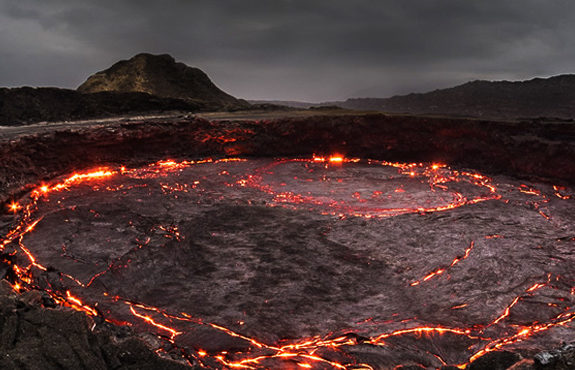
The Danakil Depression in the Afar Region of northeastern Ethiopia is one of the hottest, lowest, and most geologically active places on the planet — and one of the most spectacular destinations for adventure travellers anywhere in Africa.
Key facts:
- Elevation: Approximately 125 metres below sea level in parts.
- Temperature: Dallol, at the heart of the depression, recorded an average annual temperature of 34.4°C (94°F) between 1960 and 1966 — the highest ever measured for any inhabited location on earth.
- Erta Ale volcano: An active basaltic shield volcano that has maintained a persistent lava lake in its caldera for over a century, making it one of only five such features in the world. The name means “smoking mountain” in the Afar language. Access requires a night trek of 3–4 hours and an overnight stay at the crater rim.
- Dallol: A hydrothermal field of bubbling sulfuric acid pools, salt pillars, and vivid mineral formations in shades of yellow, green, and orange. Arguably the most surreal landscape in Africa.
- Lake Asale: A vast salt flat still worked by Afar and Tigrayan salt miners, who cut salt blocks and transport them by camel caravan across the desert — a trade unchanged for centuries.
- Access: Danakil tours depart from Mekele (Tigray’s regional capital, accessible by air from Addis Ababa). Tours require armed Afar guides and police escort — arranged by licensed operators — due to the remote and politically sensitive terrain.
Planning tip: Visit between October and February (dry season). The depression is at its most photogenic post-rainy season. Temperatures regularly exceed 45°C in summer months (June–August), making summer tours unsafe.
3. The Omo Valley — Africa’s Most Ethnographically Rich Region
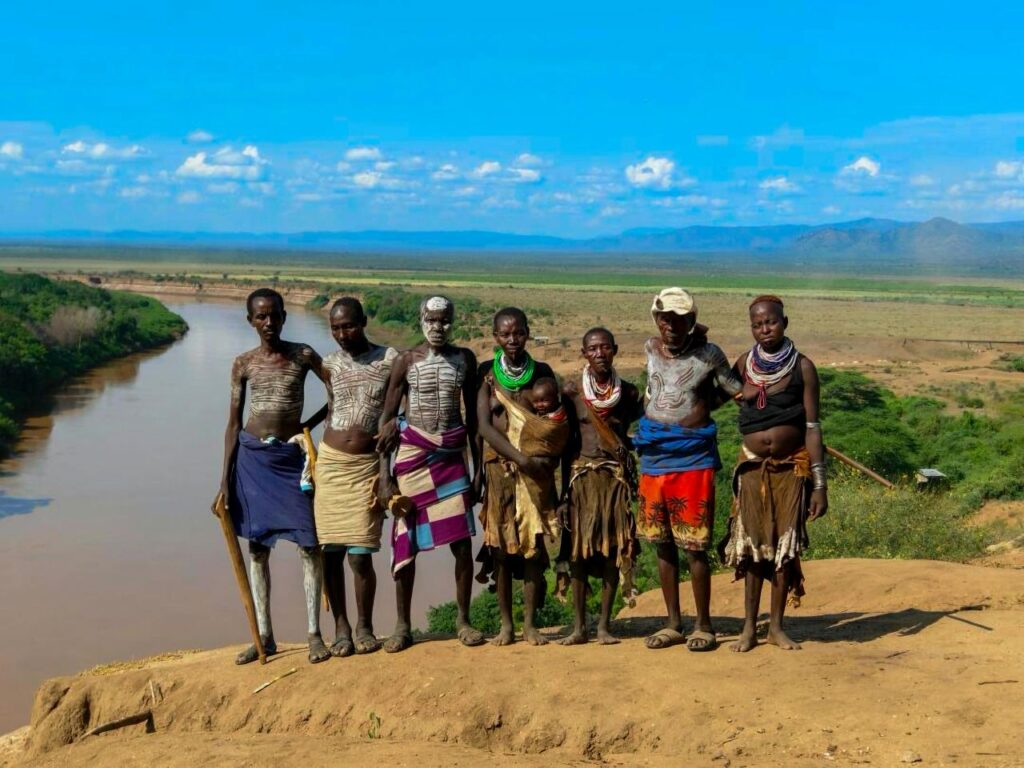
The Omo Valley in southwestern Ethiopia is home to an extraordinary concentration of indigenous ethnic groups who have maintained traditional ways of life, dress, and ceremony largely intact for centuries.
Among the groups most visited on organised tours:
- Mursi: Famous for the clay lip plates worn by women, and for elaborate body scarification. The Mursi live in the Mago National Park area near Jinka. Responsible tour operators arrange visits through community agreements rather than exploitative photo-stops.
- Hamar: Known for the bull-jumping ceremony (ukuli bula) — a male coming-of-age rite in which young men must run across the backs of a row of cattle. Hamar women also take part in ceremonial whipping rituals as acts of devotion.
- Karo: Master body painters who use ochre, white chalk, and charcoal to create intricate geometric designs. The Karo number fewer than 2,000, making them one of the smallest ethnic groups in Ethiopia.
- Dassenech: A semi-nomadic group living along the Omo River near its delta at Lake Turkana, straddling the Ethiopia-Kenya border.
- Dorze: Renowned weavers living in the highlands near Arba Minch, known for their distinctive towering bamboo hive-shaped houses which can reach 12 metres in height and are rebuilt as termites eat the base.
- Konso Cultural Landscape: A UNESCO-inscribed site (2011) featuring terraced hillside villages, wooden waka ancestor sculptures, and a sophisticated indigenous governance system (poqala) in continuous operation for over 400 years.
Responsible tourism note: The Omo Valley’s communities have become increasingly commercialised in response to mass tourism. Work with operators who have established ethical community engagement protocols, pay fair community fees, and limit group sizes. Avoid operators that treat indigenous people as photo props. We recommend pre-arranged community visits with local cultural liaisons.
4. Simien Mountains National Park — Africa’s Rooftop
The Simien Mountains are Ethiopia’s premier trekking destination and, by any measure, one of the most dramatic highland landscapes in the world.
- UNESCO designation: Simien Mountains National Park — inscribed in 1978, removed from the Endangered List in 2017 following conservation improvements.
- Ras Dashen: At 4,550 metres, Ras Dashen (Ras Dejen) is Ethiopia’s highest peak and the fourth highest in Africa.
- Gelada baboons: The Simiens are home to the world’s only wild population of gelada baboons — large ground-dwelling primates with striking red chest patches. Herds of 400–600 are commonly encountered at close range.
- Walia ibex: A critically endangered wild goat endemic to Ethiopia, found only in the Simien Mountains. Current population estimated at 500–600 individuals.
- Ethiopian wolf: The rarest canid in the world, with a total wild population of approximately 500. While more commonly seen in the Bale Mountains, occasional sightings occur in Simien.
- Trekking routes: Standard treks run 3–7 days between the trailhead at Sankaber (3,230m) and Chennek (3,620m), with optional summit pushes to Ras Dashen requiring 2–3 additional days. All treks require a licensed scout, and mule support is available for gear.
Altitude note: Altitude sickness is a genuine risk. Allow a full acclimatisation day in Gondar or Debark before beginning a Simien trek. Consult your physician about acetazolamide (Diamox) before departure.
5. Bale Mountains National Park — Ethiopia’s Wildlife Heartland
Bale Mountains National Park, inscribed as a UNESCO World Heritage Site in 2023, is Ethiopia’s most biodiverse protected area and the best single location in Africa to see the Ethiopian wolf.
- Ethiopian wolf: The Sanetti Plateau (3,500–4,000m) in Bale provides the highest density of Ethiopian wolf sightings in the world, particularly in the early morning and late afternoon.
- Mountain nyala: A large antelope endemic to Ethiopia, found only in the Bale Mountains and nearby highlands. Estimated population: 2,500–4,000.
- Harenna Forest: One of the largest remaining Afromontane forests in Africa, with an extraordinary biodiversity of orchids, giant heather trees, and forest-dwelling wildlife including lion and African wild dog.
- Trekking: The 8-day Bale Mountains traverse from Dinsho to the Harenna Forest offers one of the finest and least-crowded wilderness treks in Africa.
- Nearest access city: Robe (Goba), approximately 400 km from Addis Ababa by road or accessible by regular flights.
6. Harar Jugol — The Walled Islamic City
Harar is considered the fourth holiest city in Islam, after Mecca, Medina, and Jerusalem, and is the only one located in Africa.
- UNESCO designation: Harar Jugol, the Fortified Historic Town — inscribed in 2006.
- Scale: The old walled city (Jugol) contains 82 mosques (three dating from the 10th century), 102 shrines, and a labyrinth of narrow alleyways. The walls were built in the 16th century.
- The hyena men: A unique Harari tradition in which wild spotted hyenas are fed by hand each night at two sites near the city walls. This practice dates back at least 500 years and remains one of Ethiopia’s most remarkable wildlife-human interactions.
- Arthur Rimbaud’s house: The French poet Arthur Rimbaud lived and worked in Harar from 1880–1891 as a coffee and arms trader. His residence is preserved as a small museum.
- Trade history: Harar was a crucial node on the Indian Ocean trade network, connecting the Ethiopian interior with Djibouti, the Arabian Peninsula, and beyond.
7. Addis Ababa — Africa’s Political Capital
Addis Ababa (meaning “New Flower” in Amharic), founded in 1886, sits at 2,355 metres elevation and serves as the headquarters of the African Union and the United Nations Economic Commission for Africa.
Key sites for visitors:
- National Museum of Ethiopia: Houses the fossil remains of Lucy (Australopithecus afarensis) — one of the most famous hominid discoveries in history, dating to 3.2 million years ago, found in the Afar region in 1974. The museum also has an outstanding ethnographic collection.
- Holy Trinity Cathedral: The second most important Ethiopian Orthodox church after St. Mary of Zion in Axum. Haile Selassie and Empress Menen are buried here.
- Merkato: One of the largest open-air markets in Africa, covering several square kilometres and organised into specialised sections for spices, fabrics, gold, khat, and household goods.
- Entoto Hill: The forested ridge above the city, site of Menelik II’s original palace and the Church of Entoto Maryam. Excellent views of the city and a glimpse into pre-modern Addis Ababa.
- Ethiopian Cuisine: Addis Ababa is the best place to experience injera (fermented teff flatbread) with the full range of Ethiopian wot (stews). Carnivores should not miss kitfo (minced raw beef) and tibs (pan-fried meat). The capital also has a thriving coffee shop culture.
Tour Types We Offer for Ethiopia
Cultural & Historic Route Tours (7–12 Days)
The classic Ethiopia itinerary covering Addis Ababa, Bahir Dar, Gondar, Lalibela, and Axum. Typically flies between major sites on Ethiopian Airlines’ domestic network, which is extensive and relatively affordable.
Adventure & Trekking Tours (8–14 Days)
Designed around the Simien Mountains, Bale Mountains, or both. Can be combined with a cultural leg through the north.
Danakil & Afar Expedition Tours (4–6 Days)
Specialist small-group expeditions to Erta Ale and Dallol. Require physical fitness and heat tolerance. Departures are from Mekele.
Omo Valley & South Ethiopia Cultural Tours (7–10 Days)
In-depth immersion in the ethnographic wealth of the southwest, typically routing through Arba Minch, Jinka, Turmi, Konso, and Hawassa (Lake Hawassa, famous for its pelicans and fish market).
Combined North–South Epic Tours (14–21 Days)
Our most comprehensive Ethiopia experience, combining the Historic Route, Danakil Depression, and Omo Valley. Best for travellers making a once-in-a-lifetime visit.
Birdwatching Tours (7–14 Days)
Ethiopia has 920+ recorded bird species, including 23 endemics — among them the Thick-billed Raven, Blue-winged Goose, and Wattled Ibis. The Bale Mountains and Rift Valley lakes are the premier birding circuits.
Festival Tours (Variable Duration)
Timed around Ethiopia’s major religious and cultural festivals:
- Timkat (Ethiopian Epiphany) — January 19–20: celebrated most spectacularly in Gondar and Lalibela
- Genna (Ethiopian Christmas) — January 7: Lalibela is the premier destination
- Meskel (Finding of the True Cross) — September 27: celebrated with a massive bonfire ceremony in Addis Ababa’s Meskel Square, attended by hundreds of thousands
- Irreecha (Oromo Thanksgiving) — October: the largest cultural gathering in Ethiopia, held at Lake Hora in Bishoftu (Debre Zeit)
Ethiopia Trip Packages
Ethiopia’s 12 UNESCO World Heritage Sites at a Glance
| SITE | YEAR INSCRIBED | TYPE |
|---|---|---|
| Rock-Hewn Churches, Lalibela | 1978 | Cultural |
| Simien Mountains National Park | 1978 | Natural |
| Aksum | 1980 | Cultural |
| Fasil Ghebbi, Gondar | 1979 | Cultural |
| Lower Valley of the Awash (Lucy) | 1980 | Cultural |
| Lower Valley of the Omo | 1980 | Cultural |
| Tiya Stelae | 1980 | Cultural |
| Harar Jugol | 2006 | Cultural |
| Konso Cultural Landscape | 2011 | Cultural |
| Gedeo Cultural Landscape | 2023 | Cultural |
| Bale Mountains National Park | 2023 | Natural |
| Melka Kunture & Balchit | 2024 | Cultural |
Best Time to Visit Ethiopia
Ethiopia’s climate divides into two seasons with significant regional variation:
Dry Season (October–May) — Prime Travel Window
- October–November: Ideal. Post-rains landscape is lush and green, skies are clear, temperatures are moderate. The best months for photography.
- December–February: Peak season. Lalibela in January for Genna and Timkat is unforgettable, though accommodation must be booked far ahead. Danakil is best in this window.
- March–May: Increasingly warm. A short secondary rainy period (belg) can bring brief afternoon showers to some highland areas but generally does not disrupt travel.
Wet Season (June–September) — With Caveats
- The main rains (kiremt) fall from June–September, heaviest in July–August. Highland roads can become impassable. Lalibela and Simien trekking are less pleasant.
- Exception: The Omo Valley and lower-altitude regions are still visitable June–September. Danakil should be avoided — temperatures can exceed 50°C.
- Addis Ababa celebrates Meskel (late September) and the Ethiopian New Year (11 September) — both excellent festival travel opportunities at the tail of the rains.
Practical Information for Ethiopia Travellers
Entry Requirements & Visas
Most nationalities require a visa to enter Ethiopia. There are three routes:
- e-Visa (recommended): Apply online at www.evisa.gov.et before departure. Available to nationals of 37+ countries including the USA, UK, EU states, Canada, Australia, and others. Standard tourist e-visa is valid for 30 days single entry. Process takes approximately 2–3 business days. Your passport must have at least 6 months’ validity from the intended entry date.
- Visa on Arrival: Available to all African Union and European Union member state nationals at Addis Ababa Bole International Airport (Terminal 2). A 30-day tourist visa is typically issued upon payment of the fee.
- Visa Exemption: Citizens of Kenya and Djibouti do not require a visa.
Important: Always verify current requirements with the Ethiopian Immigration and Citizenship Service or your nearest Ethiopian Embassy before travelling, as policies change. Entry is only permitted through Addis Ababa Bole International Airport for e-visa holders.
Getting to Ethiopia
Ethiopian Airlines (ethiopianairlines.com) is the primary gateway. It operates direct or one-stop flights from over 95 international destinations and has the most comprehensive hub network in Africa. Addis Ababa Bole International Airport (ADD) is 5 km from the city centre.
Ethiopian Airlines’ extensive domestic network connects Addis Ababa with Lalibela, Axum, Gondar, Bahir Dar, Mekele, Jinka, Arba Minch, Hawassa, and others — making internal flight connections a practical and time-saving option for most itineraries.
Health Recommendations
- Yellow fever vaccination is required if arriving from a yellow fever-endemic country. A vaccination certificate must be presented at immigration.
- Malaria is present at lower altitudes (below 2,000m), including the Omo Valley and parts of the Danakil. Pack prophylaxis and use DEET repellent. The highlands (Lalibela, Gondar, Addis Ababa) are malaria-free.
- Altitude: Addis Ababa sits at 2,355m; Lalibela at 2,630m; Simien Mountains up to 4,550m. Allow 24–48 hours to acclimatise before strenuous activity.
- Water: Drink bottled water only. Avoid salads and raw vegetables in local restaurants unless you are confident of preparation standards.
- Consult your travel doctor or refer to the CDC’s Ethiopia travel health page at least 4–6 weeks before departure.
Currency & Money
- Currency: Ethiopian Birr (ETB). The exchange rate fluctuates; check the current rate at XE.com.
- USD, EUR, and GBP are readily exchangeable at banks and official exchange bureaus in Addis Ababa and major tourist towns.
- ATMs are available in Addis Ababa and larger cities. Cash is essential outside major urban areas.
- Credit cards are accepted at upmarket hotels and some restaurants in Addis Ababa. Outside the capital, expect a cash-only environment.
- Customs: It is illegal to take more than 200 Birr out of Ethiopia. Declare any cash exceeding USD 3,000 upon entry.
Safety
Ethiopia is a large and diverse country. Safety conditions vary significantly by region. As of 2025:
- Addis Ababa and the main tourist circuit (Lalibela, Gondar, Axum, Bahir Dar, Bale, Simien) are generally safe for tourists travelling with a reputable operator.
- Tigray region (including Axum and Mekele) has reopened to tourism following the end of the 2020–2022 conflict, but travellers should check current advisories before booking. UK FCDO Ethiopia Travel Advice and the US State Department Ethiopia Advisory are the most reliable sources.
- Danakil and border areas require armed escort and should only be visited with experienced, licensed operators.
- Purchase comprehensive travel insurance that includes emergency medical evacuation.
Why Book Your Ethiopia Tour Through African Travel Hub
We specialise in tailor-made Ethiopia itineraries built around your pace, interests, and budget. Every tour we design is:
- Expert-guided: All our Ethiopia tours use licensed local guides with in-depth knowledge of history, culture, ecology, and language. Most carry government accreditation and are members of the Ethiopia Tour Operators Association (ETOA).
- Logistically watertight: Internal flights, ground transport, accommodation, entry fees, and community permits are pre-arranged. We handle the complexity so you don’t have to.
- Ethically grounded: We work with community-owned guesthouses, local restaurants, and Afar community guides in the Danakil. Our Omo Valley itineraries are built around ethical engagement protocols developed in consultation with local community leaders.
- Flexible: Tours can start any day of the year. Groups of 1–16 are accommodated. Private departures are available year-round.
Ready to plan your Ethiopia journey? Contact our Africa specialists for a no-obligation itinerary and quote. Most Ethiopia enquiries receive a full draft itinerary within 48 hours.
Frequently Asked Questions: Ethiopia Tours
How many days do you need in Ethiopia? A minimum of 7–8 days covers the core Historic Route (Addis Ababa, Lalibela, Gondar, Bahir Dar). Allow 12–14 days to add the Danakil Depression or Omo Valley. For a comprehensive north-south experience, 18–21 days is ideal.
Is Ethiopia suitable for first-time Africa travellers? Yes, but Ethiopia is best experienced with a reputable operator. The infrastructure, while fast-improving, is not as mature as East Africa. Having a knowledgeable guide transforms the experience entirely.
What is the food like? Ethiopian cuisine is one of Africa’s most distinctive. The national dish is injera — a spongy sourdough flatbread made from teff (a native grain) — served with an array of meat and vegetarian stews. Ethiopia has a strong vegetarian tradition rooted in Orthodox fasting days (roughly 180 fasting days per year for devout Orthodox Christians). Shiro (spiced chickpea stew) and atkilt (vegetable dishes) are outstanding. Coffee — roasted and brewed freshly — is exceptional everywhere.
Can you combine Ethiopia with other countries? Yes. Common combinations include Ethiopia + Kenya (through Nairobi or via the Omo Valley/Lake Turkana corridor), Ethiopia + Tanzania, and Ethiopia + Djibouti (for those wanting to witness the Danakil from both sides of the border). Ethiopian Airlines’ hub position makes multi-country routing practical.
Is Ethiopia safe for solo female travellers? Ethiopia is generally safe for solo female travellers within the main tourist circuit. Harassment in Addis Ababa is relatively common (similar to other African capitals) but rarely threatening. Travelling with a local guide eliminates most concerns.
Page updated April 2025. Visa requirements, safety advisories, and UNESCO designations are subject to change. Always verify current conditions with official sources before travel.