
Last Updated on April 25, 2026 by African Travel Hub Editorial
Zimbabwe Tours and Safaris
Expert-Planned Safari Itineraries | Africa Travel Hub
Zimbabwe is one of Southern Africa’s most rewarding safari destinations, offering Victoria Falls — the world’s largest waterfall by combined width and height — alongside Hwange National Park (14,651 km²), Mana Pools UNESCO World Heritage Site, and the ancient granite kopjes of Matobo Hills. Visitor numbers remain low compared to neighbouring countries, meaning genuine wilderness, uncrowded parks, and intimate wildlife encounters are still standard here.
Why Zimbabwe Should Be on Your Safari Itinerary
Zimbabwe sits between the Zambezi River to the north and the Limpopo River to the south, spanning 390,757 km². Its interior plateau averages 1,200 m above sea level, producing a moderate subtropical climate that supports diverse ecosystems — from mopane woodland and teak forests to riverine floodplains and granite highlands. Despite decades of economic turbulence, Zimbabwe’s national parks have been steadily recovering, with elephant populations in Hwange now exceeding 45,000 — the largest concentration in Africa.
For safari travellers, lower visitor volumes translate directly into higher-quality wildlife encounters. Unlike the heavily trafficked circuits of Kenya or Tanzania’s northern corridor, a morning game drive in Mana Pools or Hwange frequently involves just your vehicle and a pride of lions.
Zimbabwe’s 5 Essential Safari Destinations
1. Victoria Falls — The Smoke That Thunders
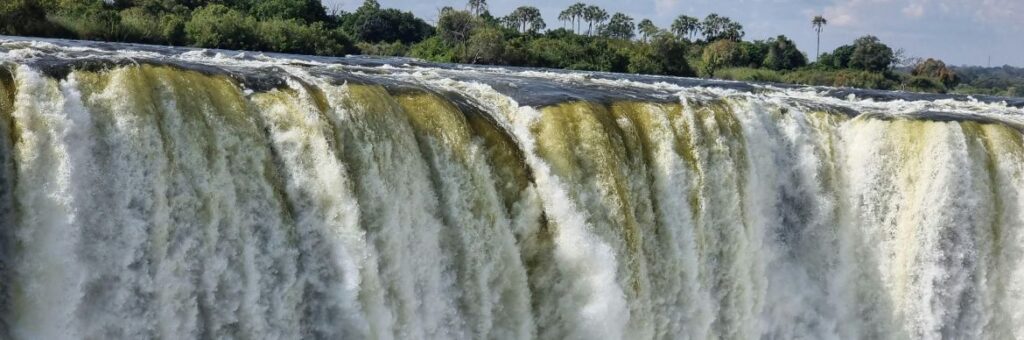
Victoria Falls (Mosi-oa-Tunya) straddles the Zimbabwe-Zambia border on the Zambezi River. At full flood (February–May), the falls discharge up to 500,000 m³ per minute across a 1,708-metre-wide cataract that plunges 108 metres. Key activities include:
- Flight of Angels helicopter circuit — 13–15 minutes over the full falls width, best at peak flow
- Devil’s Pool swimming — accessible August–January when water levels are low
- White-water rafting on Zambezi Grade 5 rapids (Rapid 1–23), suitable from August–December
- Sunset Zambezi cruises — prime wildlife and birdwatching from the river
- Walking safaris in Zambezi National Park, which begins immediately upstream of the falls
2. Hwange National Park — Zimbabwe’s Largest Wildlife Reserve
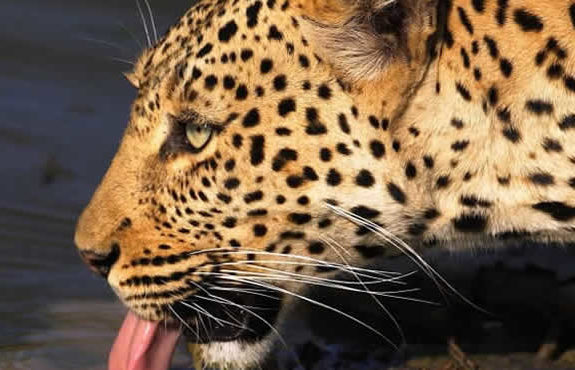
At 14,651 km², Hwange is Zimbabwe’s premier game reserve and the country’s largest national park. It holds Africa’s highest density of elephant and supports one of the continent’s most impressive lion populations (est. 500+). The park’s flat terrain and artificial waterholes — over 60 pumped during the dry season — concentrate game dramatically from June through October. Key wildlife includes African wild dog (Hwange holds one of the world’s most significant populations), sable antelope, roan antelope, cheetah, leopard, and all of Africa’s Big Five.
Best base: Linkwasha Camp or Little Makalolo — both are inside the Linkwasha Concession in the remote south of the park, with virtually no other vehicles.
3. Mana Pools National Park — UNESCO World Heritage & Canoe Safari Capital
Mana Pools occupies 2,196 km² of the Zambezi Valley floor and is one of Africa’s only parks where walking and canoeing safaris are the primary modes of game viewing. The floodplain pools — Main Pool, Long Pool, Chine Pool, and Jessie Pool — fill each rainy season and retain water well into the dry season (April–October), creating outstanding concentrations of hippo, crocodile, elephant, Cape buffalo, and lion. The park is renowned for its elephant population’s unusual foraging behaviour: bulls here have learned to stand on their hind legs to reach acacia pods.
4. Matobo Hills National Park — Rock Art and Rhino
Located 35 km south of Bulawayo, Matobo Hills is Zimbabwe’s oldest national park (declared 1926) and a UNESCO World Heritage Site. The park’s dramatic balancing granite boulders contain one of the highest concentrations of San (Bushman) rock art in the world — over 3,000 documented sites. Matobo also houses Zimbabwe’s most successful white and black rhino conservation programme; guided rhino tracking on foot gives an unmatched close encounter. Cecil John Rhodes is buried here at World’s View (Malindidzimu Hill), a site sacred to the Ndebele people.
5. Lake Kariba — Africa’s Largest Man-Made Lake
Lake Kariba (5,400 km²) was created in 1959 by the Kariba Dam on the Zambezi River. Houseboat safaris on Kariba offer a completely different perspective: fishing for tiger fish, game viewing along the shoreline from the water, and spectacular sunsets over the Matusadona National Park escarpment. Matusadona itself — 1,370 km² on the lake’s southern shore — is home to black rhino, lion, elephant, and significant hippo populations.
Best Time to Visit Zimbabwe
Zimbabwe has two primary seasons for safari:
Dry Season (May–October): Peak safari season. Vegetation thins, animals concentrate at waterholes, and game viewing is at its most productive. Temperatures in the Zambezi Valley can exceed 40°C in October. Night temperatures in July–August drop to 10°C or below on the highveld.
Wet / Green Season (November–April): Lush and photogenic; lower rates at most camps. Migratory bird species arrive in November. Hwange is less productive for big game viewing, but Mana Pools and Matobo remain rewarding. Victoria Falls is at peak flow from February–May.
Practical Safari Planning Facts
| CATEGORY | DETAIL |
|---|---|
| Visa | Visa-on-arrival available for most nationalities; KAZA Univisa ($50) covers Zimbabwe + Zambia |
| Currency | USD is the primary transactional currency; carry small denominations ($1–$20) |
| Entry Point | Victoria Falls International Airport (VFA) — most visitors fly in via Johannesburg (JNB) |
| Vaccinations | Yellow fever certificate required if arriving from endemic countries; malaria prophylaxis essential |
| Park Fees | Hwange: $20/person/day; Mana Pools: $15/person/day; Matobo: $15/person/day (2024 rates) |
| Safari Style | Mix of fly-in camps, self-drive (Hwange), guided walking, canoe, and houseboat safaris available |
Recommended Zimbabwe Safari Itineraries
5 Days — Victoria Falls & Hwange Fly-In: 2 nights Victoria Falls town / 3 nights Hwange (Linkwasha Concession). Combine the falls activities with intense game drives. Best May–October.
8 Days — Classic Zimbabwe Triangle: 2 nights Victoria Falls / 3 nights Hwange / 3 nights Mana Pools. Covers Zimbabwe’s top three ecosystems. Fly between parks. Best June–September.
10 Days — Zimbabwe & Botswana Combined: Victoria Falls as gateway, continuing into the Okavango Delta and Chobe National Park via light aircraft or road transfer. Best August–October for peak game concentration on both sides of the border.
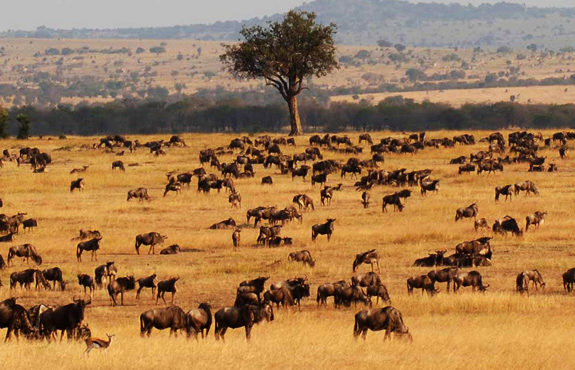
14 Days — Multi-Country Grand Safari: Victoria Falls → Hwange → Mana Pools → Matobo Hills → Maasai Mara or Serengeti. Best June–October. Combines Zimbabwe’s wilderness with East Africa’s wildebeest migration.
Plan Your Zimbabwe Safari with Africa Travel Hub
All Zimbabwe itineraries are tailor-made. We arrange flights, park permits, transfers, and accommodation across all budget levels — from tented camps to private luxury lodges. Every safari is led by ZINC-licensed guides.
🇺🇸 USA & Canada: 1-888-885-4580 | 🇬🇧 UK: 0-800-051-4252 | 🇰🇪 Kenya: +254 795 891 706
www.africantravelhub.com