

Last Updated on April 27, 2026 by African Travel Hub Editorial
Tanzania – Pre-Travel Information Package
Tanzania is Africa’s single most complete safari destination — home to the world’s greatest wildlife spectacle (the Great Migration), the continent’s highest peak (Kilimanjaro at 5,895m), the world’s largest intact volcanic caldera (Ngorongoro), and some of the Indian Ocean’s most spectacular beaches (Zanzibar). Nearly 38% of Tanzania’s total land area is protected under national parks, game reserves, and conservation areas — the highest proportion of any country in Africa. For first-time and repeat safari travellers alike, Tanzania consistently delivers more concentrated wildlife drama across more diverse habitats than any competitor destination.
1. Why Tanzania Leads Africa for Wildlife Safaris
Tanzania’s dominance in the safari world rests on a unique convergence of scale, diversity, and protection:
- Serengeti National Park (14,763 km²) supports the largest concentration of large mammals on Earth, including a resident wildebeest population of approximately 1.5 million animals.
- Ngorongoro Crater is the world’s largest intact volcanic caldera — 260 km² of floor enclosed by 600m walls — sustaining over 25,000 large mammals year-round without seasonal migration.
- Nyerere National Park (formerly Selous, 30,893 km²) is the largest protected area in Africa and a UNESCO World Heritage Site. It holds the world’s densest concentration of elephants.
- Ruaha National Park (20,226 km²) is Tanzania’s largest national park and one of the last strongholds for the endangered African wild dog, with a population of over 3,000 — nearly 10% of the world’s remaining wild dogs.
- Tarangire National Park hosts the highest density of elephants of any park in Tanzania during the dry season (July–October), with herds of several hundred animals converging on the Tarangire River.
Tanzania is one of the only destinations on Earth where a single trip can yield the Big Five (lion, leopard, elephant, buffalo, black rhino), Big Seven (adding cheetah and wild dog), and a significant bird list of 1,100+ species — all within a standard 7–10 day itinerary on the northern circuit.
2. The Great Wildebeest Migration: A Month-by-Month Planner
The Great Migration is the largest overland wildlife movement on Earth — a perpetual, year-round cycle involving 1.5 to 2 million wildebeest, 200,000–300,000 zebra, and 400,000+ gazelle moving clockwise through the Serengeti-Mara ecosystem. No other wildlife event on the planet matches its scale.
Key Planning Principle: The Migration is not a single event — it is a continuous 12-month cycle. The question is never if you’ll see migration, but what phase you’ll encounter and where to position yourself.
Month-by-Month Migration Location Guide
| MONTH | LOCATION | WHAT TO EXPECT |
|---|---|---|
| December - March | Southern Serengeti / Ndutu Plains | Calving season. Over 500,000 calves born in a compressed 2–3 week window (peak: February). Intense predator action — cheetah, lion, hyena. Lush green scenery, excellent photography. Fewer crowds than peak season. |
| April - May | Central & Western Serengeti | Green season movement north. Long rains begin. Lower tourism prices. Herd columns stretching for kilometres visible. |
| June - July | Western Corridor / Grumeti River | Grumeti River crossings begin. Large Nile crocodiles ambush herds. June marks the start of dry season — excellent visibility, increasingly dramatic wildlife action. |
| August - October | Northern Serengeti / Mara River | Peak season. Mara River crossings. The most filmed and photographed phase. Thousands of wildebeest plunge into crocodile-filled water in mass crossings at Kogatende and the Lamai Wedge. Book 12–18 months in advance for premium camps. |
| November | Eastern Serengeti | Short rains trigger southward return. Herds move rapidly through eastern Serengeti. |
| December | South-Eastern Serengeti / Ndutu | Cycle repeats — herds arrive in Ndutu as rains stimulate fresh grass growth. |
Expert Planning Notes
- River crossings are unpredictable. Even expert guides cannot predict the exact day herds will cross. Staying minimum 3–4 nights in the northern Serengeti (July–October) significantly increases your odds of witnessing a crossing.
- Climate change impact: Tanzania’s long and short rains are increasingly irregular, causing the migration timeline to shift. Always consult a current, on-the-ground operator for real-time herd position.
- Calving season (January–March) is significantly underrated. The predator activity around newborn calves rivals anything seen during river crossings and comes with dramatically fewer tourist vehicles.
- Best value window: May–June offers the Grumeti crossings, the end of long rains, and accommodation rates 30–50% below peak season prices.
Official Serengeti Park information: Tanzania National Parks Authority (TANAPA)
3. Tanzania’s Northern Safari Circuit
The Northern Circuit — accessed from Arusha (3.5 hours from Kilimanjaro International Airport or 45 minutes from Arusha Airport) — is Tanzania’s most popular safari region and the primary stage for the Great Migration. It encompasses five major destinations that can be combined in one continuous road loop or via internal flights.
Serengeti National Park
Size: 14,763 km² | UNESCO World Heritage Site | Established: 1951
Serengeti is the world’s most famous national park and the centrepiece of any Tanzania safari. The name derives from the Maasai word Siringit, meaning “endless plains” — an accurate description of the vast, open savanna that stretches to the horizon.
Key wildlife statistics:
- Lions: Serengeti has one of the highest concentrations of lions in Africa, with an estimated 3,000+ individuals.
- Leopard: Particularly visible in the Seronera Valley, where fig trees along river courses provide reliable daytime resting spots.
- Cheetah: Serengeti’s open plains make it one of Africa’s best locations for cheetah viewing; the short grass plains around Ndutu are especially productive.
- Elephant: Concentrated in the Seronera region and western corridor; note that elephants are scarcer than in Tarangire or the southern circuit.
- Black Rhino: Restricted to the Moru Kopjes area; sightings are rare but possible.
- Wildebeest: Resident population of approximately 1.5 million, plus zebra (c.200,000), Thomson’s gazelle, Grant’s gazelle, topi, eland, and impala.
Zones of the Serengeti:
- Seronera (Central): Year-round wildlife hub. Best base for first-time visitors. Excellent leopard and lion sightings.
- Ndutu & Southern Plains: Prime calving season destination (December–March). Short-grass plains, extraordinary predator density.
- Western Corridor: Grumeti River crossings (June–July). Less visited, more intimate.
- Northern Serengeti (Kogatende/Lamai): Peak-season Mara River crossing territory (August–October). Most dramatic and most sought-after.
Getting there: Road transfer from Arusha takes 6–8 hours (passing through Ngorongoro). Internal flights from Arusha or Kilimanjaro to Seronera, Grumeti, or Kogatende airstrips take 45–90 minutes and are strongly recommended for northern zone access.
Ngorongoro Conservation Area
Size: 809,440 ha | UNESCO World Heritage & Mixed Heritage Site | Designated: 1979 (Natural), 2010 (Mixed)
Official site: Ngorongoro Conservation Area Authority (NCAA)
The Ngorongoro Crater is one of Africa’s Seven Natural Wonders and — by many measures — the single most wildlife-dense location on the African continent.
The Crater in numbers:
- Dimensions: 260 km² floor, 20 km diameter, 600m walls
- Formation: Collapsed approximately 2.5 million years ago from a volcano estimated to have been the size of Kilimanjaro
- Wildlife: Over 25,000 large mammals resident year-round — one of the highest densities on Earth
- Lions: More than 50 lions resident inside the crater — among the highest density per km² of any protected area in Africa
- Black Rhino: Ngorongoro is one of the most reliable locations in East Africa to see black rhino. All individuals are fitted with GPS tracking devices to deter poaching. Numbers are closely guarded but are believed to be around 20–30 animals.
- Elephant: The crater hosts famous large-tusked bull elephants, many with tusks rarely seen elsewhere due to reduced poaching pressure. Note: breeding herds do not reside in the crater — only large bulls.
- Birds: 550+ species recorded across the broader Conservation Area; flamingos gather at Lake Magadi on the crater floor.
Important visiting notes:
- Only 4WD vehicles are permitted on the crater floor.
- Walking inside the crater is not permitted due to lion risk (walking is allowed on the crater rim and in other parts of the NCA).
- You are limited to one descent per vehicle per day.
- Time your descent for 6:30–7:00 AM to maximise wildlife activity before mid-morning crowds arrive.
- Crater floor altitude is 1,800m ASL — bring a jacket even during dry season.
Olduvai Gorge: Located within the NCA, this 14km ravine contains hominid fossils and artefacts dating back 1.75 million years, including early Homo habilis remains. Often called the “Cradle of Mankind.” A brief guided visit pairs naturally with a Ngorongoro game drive.
Tarangire National Park
Size: 2,850 km² | Located 120 km south of Arusha (2 hours by road)
Tarangire is dramatically underrated relative to Serengeti and Ngorongoro, yet offers some of the finest wildlife viewing in East Africa — particularly from July through October, when the Tarangire River becomes the only permanent water source in the region and draws a mass convergence of animals from hundreds of kilometres around.
Why Tarangire deserves more attention:
- Elephant density: During the dry season, herds of 200–300 elephants are routinely sighted along the river. Tarangire consistently records the highest elephant concentrations of any park in Tanzania during this period.
- Baobab trees: Tarangire’s ancient baobabs (some estimated at over 1,000 years old) create an iconic, primeval landscape unlike any other park in Tanzania.
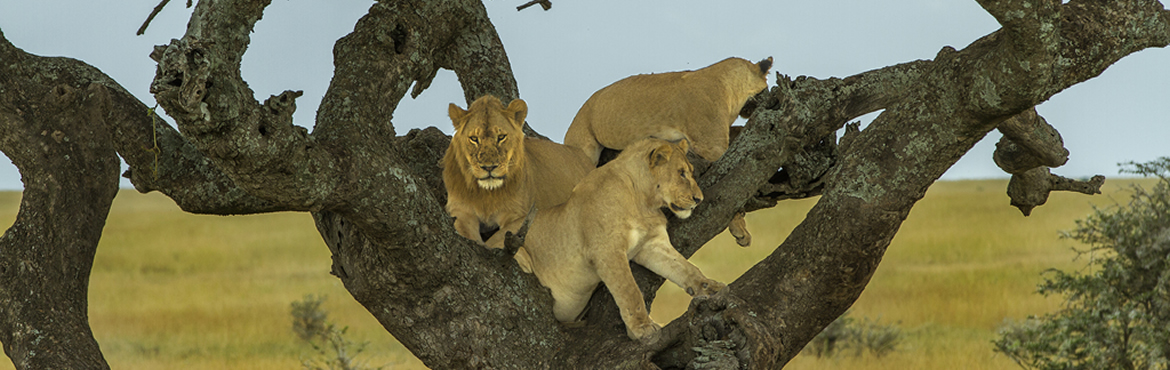
- Tree-climbing lions: Tarangire, alongside Lake Manyara, is one of the few places in Africa where lions are regularly observed climbing trees — a behaviour linked to tsetse flies, thermoregulation, and learned tradition.
- Specialist species: Fringe-eared oryx, gerenuk, and lesser kudu — all difficult or impossible to find in Serengeti — are resident here.
- Bird diversity: 550+ species, including the endemic ashy starling and the spectacular yellow-collared lovebird.
- Fewer crowds: Even during peak season, Tarangire sees a fraction of the vehicle density found in Serengeti’s Seronera Valley.
Best time: July–October for maximum elephant concentrations and predator activity. Avoid during short dry season lull (November–December) when animals disperse widely.
Lake Manyara National Park
Size: 648 km² (of which 230 km² is the soda lake itself) | Located 126 km from Arusha (2 hours)
Manyara is compact and often used as a first-night stop on the northern circuit route, but it rewards time and attention disproportionate to its size.
Highlights:
- Tree-climbing lions: Lake Manyara was the location where this behaviour was first documented and remains the most reliable location to observe it.
- Elephant herds: Large family groups are regularly seen in the groundwater forest near the park entrance.
- Flamingos: Up to one million lesser and greater flamingos gather on the alkaline lake in season, creating one of Africa’s most extraordinary visual spectacles.
- Hippo pool: A permanent pool near the Hippo Point picnic site is home to a large resident pod.
- Buffalo: The lake shore and woodland areas hold substantial herds.
- Birdlife: 400+ species, making it one of Tanzania’s premier birding destinations. Pel’s fishing owl, silvery-cheeked hornbill, and African broadbill are sought-after targets.
The park’s narrow topography — squeezed between the Rift Valley escarpment and the lake shore — creates a remarkably compressed diversity of habitats: groundwater forest, acacia woodland, alkaline lake, open floodplains, and rift wall forest, all visible within a single day’s drive.
Arusha: Your Northern Circuit Base
All northern circuit safaris depart from Arusha (pop. ~400,000), Tanzania’s safari capital. Key facts:
- Kilimanjaro International Airport (JRO): 46 km east of Arusha (45 min drive); the primary international gateway for northern circuit visitors.
- Arusha Airport (ARK): Within town; used for domestic/charter flights to Serengeti, Zanzibar, and Manyara.
- Pre/post-safari nights: Arusha offers accommodation ranging from budget guesthouses to the Four Points Sheraton and Arusha Coffee Lodge. Plan at least one night on arrival before a long drive and one night before your international departure.
- Altitude: 1,400m ASL — pleasant and malaria-low risk compared to coastal areas.
4. Tanzania’s Southern Safari Circuit
Tanzania’s southern parks receive approximately 5% of the visitor numbers that the northern circuit attracts — despite offering wildlife experiences that many experienced safari travellers rate as superior in terms of exclusivity, authenticity, and raw wilderness scale.
Nyerere National Park (formerly Selous Game Reserve)
Size: 30,893 km² (gazetted national park portion; total ecosystem c.50,000 km²) | UNESCO World Heritage Site | Renamed 2019
Gateway: Dar es Salaam (30 min by light aircraft; 5–6 hours by road — fly-in strongly recommended)
Nyerere is the largest protected wildlife area in Africa. Its scale dwarfs Serengeti. The Rufiji River — one of East Africa’s largest river systems — forms the core of the park and supports ecosystems that define the southern circuit experience.
Why Nyerere is exceptional:
- Boat safaris on the Rufiji River: One of very few national parks in Africa where motorboat and dugout canoe safaris are standard. River safari offers hippopotamus (among the densest concentrations in Africa), enormous Nile crocodiles, and water-level proximity to wildlife impossible to replicate from a vehicle.
- Walking safaris: Unlike northern circuit parks, Nyerere has a long tradition of armed bush walks with professional guides — a fully immersive, ground-level experience.
- Wild dog: Nyerere holds one of the largest wild dog populations in Africa, with numerous pack sightings common.
- Elephants: While poaching severely reduced populations in the 1980s–1990s, Nyerere’s elephant numbers have recovered significantly and the park now holds thousands of animals.
- Fishing: Catch-and-release tiger fish and vundu catfish safaris on the Rufiji are a unique offering unavailable in northern parks.
- Zero crowds: Standard game-drive encounters involve no other vehicles in sight.
Note on UNESCO status: Nyerere’s World Heritage listing came under threat due to a proposed hydroelectric dam on the Rufiji River. As of 2025, construction of the Julius Nyerere Hydropower Project (JNHPP) — Tanzania’s largest infrastructure project — has been ongoing. Travellers should consult current advisories on how this project may affect the river ecosystem and access zones.
Ruaha National Park
Size: 20,226 km² | Tanzania’s largest national park | Gateway: Dar es Salaam or Iringa (fly-in recommended: 2.5 hours from Dar es Salaam by light aircraft)
Ruaha is one of Africa’s best-kept secrets — a vast, remote, broken landscape of rocky outcrops, baobabs, and the seasonal Great Ruaha River that concentrates wildlife in extraordinary numbers during the dry season.
Key distinctions:
- Wild dog stronghold: Ruaha National Park, alongside Nyerere, supports a critically important wild dog population. Pack sightings are among the most reliable in Africa during the dry season.
- Lion density: Ruaha holds one of Africa’s largest lion populations, with significant coalition behaviour involving groups of 4–6 males working together — behaviour rarely observed in other parks.
- Kudu: Ruaha is one of the best places in East Africa to see both greater and lesser kudu, which are uncommon in northern Tanzania.
- Elephant: Ruaha holds large elephant populations and regularly offers encounters with herds of 200+ animals during the dry season.
- Sable antelope: Uncommon elsewhere in Tanzania; Ruaha is a reliable location.
- No mass tourism: Ruaha has strict vehicle-number management at sightings. A lion kill here typically involves 2–3 vehicles maximum vs. 30–40 in Serengeti.
5. Mount Kilimanjaro: Climbing Africa’s Roof
Summit: Uhuru Peak — 5,895m (19,341 ft) ASL
Type: Dormant stratovolcano | UNESCO World Heritage Site
Annual climbers: Approximately 50,000 per year
Official Park Authority: Kilimanjaro National Park (KINAPA)
Kilimanjaro is the world’s highest free-standing mountain and the highest point in Africa — a bucket-list ascent that requires no technical climbing equipment or prior mountaineering experience. The challenge is entirely altitude-related: you are ascending nearly 4,000m of vertical gain in 5–9 days, typically beginning at tropical rainforest and ending on an arctic glacier.
Critical fact: The overall summit success rate across all routes and operators is 65–70%. Route and day-count selection is the single most important determinant of whether you reach Uhuru Peak.
The Seven Climbing Routes: A Comparison
| ROUTE | DURATION | SUCCESS RATE | CHARACTER | VERDICT |
|---|---|---|---|---|
| Lemosho | 7-9 Days | 85–92% (8-day) | Remote western start, merges with Machame at Lava Tower. Beautiful, varied scenery. Low initial crowds. | Best balance of success rate, scenery, and moderate pricing. |
| Northern Circuit | 9 Days | 90–98% | Longest route; complete circumnavigation of the northern slopes. Highest success rate of all routes. Minimal crowds. | Best for those prioritising summit success above all else. |
| Machame | 6–7 days | 50–70% | The "Whiskey Route." Most popular. Excellent scenery and good acclimatisation profile. Crowded during peak season (July–Oct). | Good choice on a 7-day itinerary; avoid 6-day option. |
| Rongai | 6–7 days | 70–85% | Northern approach from Kenya border. Quietest major route. Drier conditions — best in rainy season. Less dramatic scenery. | Best choice during April–May rains; good for solitude seekers. |
| Marangu | 5–6 days | 30–50% | The "Coca-Cola Route." Only route with hut accommodation. Shortest — and lowest success rate. Misleadingly described as "easiest." | Not recommended unless budget is the primary constraint. |
| Umbwe | 6 days | ~60% | Steepest, most direct ascent. Poor acclimatisation profile. Recommended for experienced trekkers only. | For experienced high-altitude trekkers only. |
Essential Kilimanjaro Planning Notes
Altitude sickness is the primary risk — it affects people regardless of age, fitness, or prior trekking experience. The fundamental rule: more days = better acclimatisation = higher success rate. Never choose a shorter route to save money; the cost of failing to summit (physically and financially) far exceeds one extra night on the mountain.
Best time to climb Kilimanjaro:
- January–February: Cold and clear. Excellent summit views. Some ice on the upper mountain. Good success rates.
- June–October (peak): Dry season. Most popular window. Warm days on lower slopes, very cold nights near summit. Book 6–12 months in advance.
- Avoid: April–May (long rains) and November (short rains) — slippery conditions and cloud cover on lower sections; however, these months are not impossible.
Key requirements for all climbers:
- All climbers must be accompanied by a licensed guide (independently organised climbs are not permitted).
- All climbers must pay official TANAPA park fees ($70–$100/day per person), rescue fees, and guide/porter wages — these are mandatory and non-negotiable. Budget climbs that appear unusually cheap typically shortchange porters or cut corners on safety.
- Porter welfare: Tanzania has regulations on maximum porter loads (20kg) and minimum wages. Use operators accredited by the Kilimanjaro Porters Assistance Project (KPAP) to ensure ethical treatment of your crew.
Physical preparation: No technical skills required. Cardiovascular fitness is key — 4–6 weeks of aerobic training (hiking, running, cycling) before your climb meaningfully increases summit success probability.
6. Zanzibar: The Spice Island
Official name: Zanzibar Archipelago (semi-autonomous region of Tanzania)
Main island: Unguja (commonly called “Zanzibar”)
Airport: Abeid Amani Karume International Airport (ZNZ), 7 km from Stone Town
Flight time from Dar es Salaam: 20 minutes | From Arusha: 45 minutes
Ferry from Dar es Salaam: 2 hours (high-speed catamaran)
Zanzibar is not merely a beach destination appended to a Tanzania safari itinerary — it is a layered cultural and historical destination of genuine substance that rewards time and curiosity.
Stone Town: UNESCO World Heritage City
Stone Town is the cultural and historical heart of Zanzibar and a UNESCO World Heritage Site — an extraordinary maze of coral stone buildings, carved wooden doors, mosques, churches, and former slave markets that document 1,000 years of Indian Ocean trade and cultural fusion. Key sites:
- House of Wonders (Beit al-Ajaib): The largest and most ornate historical building in Zanzibar. First building in East Africa to have electricity and an elevator (late 19th century). Currently under restoration.
- Old Fort (Arab Fort): Built in 1699 by Omani Arabs on the ruins of a Portuguese church. Now a cultural centre hosting concerts and the Zanzibar International Film Festival (ZIFF).
- Zanzibar Slave Market and Anglican Cathedral: The most affecting historical site in the archipelago. Built by the Universities’ Mission to Central Africa on the site of East Africa’s largest slave market, which was abolished in 1873 under British pressure. The cathedral altar stands on the location of the whipping post.
- Palace Museum (Beit al-Sahel): Former residence of the Sultans of Zanzibar. Traces the history of the Omani Sultanate and Zanzibar’s role in the Indian Ocean spice trade.
Beaches: Where to Go and Why
Zanzibar’s beaches vary dramatically based on geography, tidal patterns, and development level. Matching beach to expectation is essential planning:
| BEACH (AREA/LOCATION) | CHARACTER | BEST FOR |
|---|---|---|
| Nungwi (North) | White sand, calm water, lively beach bar scene, independent of tide | Swimming at all times, nightlife, water sports |
| Kendwa (North) | Similar to Nungwi but quieter; excellent for full-moon beach parties | Relaxed couples, good snorkelling |
| Matemwe (North East) | Quiet, shallow tidal flats at low tide; reef off shore; authentic village atmosphere | Divers, snorkellers, solitude seekers |
| Paje/Jambiani ( Southeast) | Long white beach, consistent wind; kite-surfing world-class | Kite surfers (peak Oct–Mar), budget travellers |
| Michamvi (East) | Boutique hotels, spectacular sunrise views | Honeymoons, luxury escapes |
Tide planning is critical on the east coast. At low tide, extensive tidal flats are exposed — beautiful but not swimmable. East coast beaches swim best 2–3 hours around high tide. Check local tide tables before booking east coast accommodation.
Spice Tours
Zanzibar earned its title “Spice Island” through centuries of cultivating cloves, nutmeg, cinnamon, black pepper, vanilla, and cardamom. A half-day spice farm tour from Stone Town remains one of the most tactile, sensory experiences available in Tanzania — a guided walk through working farms where you taste, smell, and identify spices in their natural state. Clove exports historically made Zanzibar the wealthiest city in East Africa; at peak production, the archipelago supplied 75% of the world’s cloves.
Diving and Marine Life
The waters surrounding Zanzibar form part of the Western Indian Ocean marine biodiversity hotspot. The reefs off Matemwe, Mnemba Atoll, and Chumbe Island are among East Africa’s finest:
- Mnemba Atoll: Protected marine conservation area. Spinner dolphins are frequently encountered on morning boat trips. Rich coral gardens with green and hawksbill turtles.
- Chumbe Island Coral Park: Private marine sanctuary with near-pristine reef and forest. Day trips available; limited overnight accommodation. One of the best conservation-managed reef ecosystems in the Indian Ocean.
- Whale sharks (seasonal): October–March off Diani and Ningwe. Non-feeding individuals; guided snorkel encounters are possible.
- Humpback whales: June–September migration.
Zanzibar Insurance Requirement (2024): From October 1, 2024, all visitors to Zanzibar are required to purchase a mandatory travel insurance policy from the Zanzibar Insurance Corporation (ZIC), costing approximately $45 USD, purchasable in advance online or upon arrival. Ensure this is factored into your travel budget.
7. Best Time to Visit Tanzania: Month-by-Month
Tanzania’s climate divides into two wet seasons and two dry seasons. Understanding this is fundamental to planning — both wildlife viewing quality and accessibility are directly determined by rain patterns.
Dry Seasons (Primary and Secondary)
June to October (Long Dry Season) — PEAK SAFARI SEASON
- Wildlife: Best game viewing of the year. Vegetation thinned, animals congregate at water sources. Great Migration river crossings (July–September) in northern Serengeti.
- Temperatures: Warm days (25–28°C), cold nights at altitude (Ngorongoro rim can approach 0°C). Light layers essential.
- Booking lead time required: 12–18 months in advance for premium Serengeti camps during August–September.
- Best for: First-time safari travellers, Serengeti river crossing photography, Tarangire elephant concentrations, Kilimanjaro climbing.
January to February (Short Dry Season)
- Wildlife: Calving season in Ndutu/Southern Serengeti. Exceptional predator action. Good game viewing across all parks.
- Weather: Hot and dry with some afternoon cloud build-up. Excellent visibility.
- Crowds: Moderate — significantly lower than June–October.
- Best for: Calving season safari, budget-conscious travellers wanting high-quality wildlife, Kilimanjaro climbing, Zanzibar beach holidays.
Wet / Green Seasons
November to December (Short Rains — “Vuli”)
- Brief rains, typically afternoons. Landscapes dramatically green. Migratory birds arrive. Fewer tourists and good wildlife viewing possible. Shoulder-season prices.
March to May (Long Rains — “Masika”)
- Heaviest rainfall. Some tracks inaccessible. Lowest tourism numbers = lowest prices (30–50% reductions). Serengeti landscape is extraordinarily lush and photogenic. Many lodges close in April–May.
- Not suitable for: First-time visitors wanting guaranteed access and comfort, Selous boat safaris, Tarangire (many animals dispersed), or Zanzibar beach holidays (east coast particularly wet).
Tanzania Seasonal Summary
| SEASON | MONTHS | PROS | CONS |
|---|---|---|---|
| Peak Dry | Jun-Oct | Best wildlife, river crossings | Highest prices, crowds, book early |
| Short Dry | Jan-Feb | Calving, good wildlife, moderate prices | No river crossings |
| Short Rains | Nov - Dec | Green, birding, lower prices | Some rain, reduced predictability |
| Long Rains | Mar-May | Cheapest, photogenic, solitude | Some areas inaccessible, lodge closures |
8. Practical Entry Information
Visas
As of January 30, 2025, Tanzania has officially phased out the visa-on-arrival option for most nationalities. All travellers who require a visa must obtain an eVisa in advance through the official Tanzania Immigration portal.
Apply online (recommended): visa.immigration.go.tz
Visa types and fees:
- Ordinary Tourist Visa: $50 USD | Valid up to 90 days | Single entry | For most nationalities
- Multiple Entry Visa (USA nationals only): $100 USD | Valid 1 year | USA passport holders are specifically required to apply for this type — a standard ordinary visa is not available for American citizens
- Transit Visa: $30 USD
Key requirements:
- Passport valid for at least 6 months beyond entry date, with at least 1–2 blank pages
- Proof of onward/return travel (required at immigration)
- Accommodation confirmation
- Processing time: 7–10 working days — apply at minimum 2 weeks before travel, ideally 3–4 weeks
- Zanzibar is covered under the same visa as mainland Tanzania — no separate Zanzibar visa is required
Visa-free entry: A limited number of countries — primarily East African Community members and some Commonwealth nations — have visa-free access for up to 90 days. Check the full list at the Tanzania Embassy Washington D.C. or the official eVisa portal.
Referral Visa category: Nationals of certain countries cannot apply via the standard eVisa system and require advance clearance from the Commissioner General of Immigration. Do not book flights before visa clearance is confirmed if your nationality falls into this category.
Health & Vaccinations
Yellow Fever: Required only if arriving from a yellow-fever-endemic country (includes most of sub-Saharan Africa, much of South America). Carry your Yellow Card if applicable — immigration officers will check it at the border.
Malaria: Present throughout Tanzania, including Zanzibar. Risk varies by altitude (Ngorongoro and Kilimanjaro at altitude have low risk; coast and lowland parks are higher risk). Consult your travel health clinic for current prophylaxis recommendations. Use DEET-based repellent regardless of prophylaxis choice.
Recommended vaccines (consult your travel health provider):
- Hepatitis A and B
- Typhoid
- Tetanus/diphtheria
- Meningitis (if travelling during dry season)
- Rabies (for extended travel or those working with animals)
Other health notes:
- Tap water is not potable — drink bottled or treated water throughout Tanzania, including Zanzibar. Premium lodges typically provide purified water.
- The nearest medical facilities of international standard are in Arusha, Dar es Salaam, and Zanzibar Town. Remote park areas have basic first aid only. Travel insurance with medical evacuation cover is non-negotiable for safari travel.
Getting to Tanzania: Main Entry Points
| AIRPORT | IATA CODE | PRIMARY USE | INTERNATIONAL CONNECTIONS |
|---|---|---|---|
| Julius Nyerere International (Dar es Salaam) | DAR | Southern circuit, Zanzibar ferry | Ethiopian, Kenya Airways, Qatar, Turkish, KLM, Swiss |
| Kilimanjaro International | JRO | Northern circuit (Arusha/Serengeti) | Ethiopian, Kenya Airways, Qatar, KLM, Condor, RwandAir |
| Abeid Amani Karume (Zanzibar) | ZNZ | Zanzibar direct | Precision Air, Ethiopian, Turkish, Flydubai, Oman Air |
Recommended routing for northern circuit: Fly into JRO (Kilimanjaro), transfer to Arusha, begin safari. Fly out from ZNZ (Zanzibar) after post-safari beach extension. Many travellers do this as an open-jaw booking.
Currency & Money
- Currency: Tanzanian Shilling (TZS), but USD is widely accepted at lodges, camps, and park gates. USD notes must be issued 2009 or later — many operators and ATMs reject older bills.
- ATMs: Available in Arusha, Dar es Salaam, and Zanzibar Town. Not available inside national parks.
- Credit cards: Accepted at major lodges and hotels; surcharges common. Carry USD cash for tips, small purchases, and remote areas.
- Tipping: Expected and important to the local economy. Suggested rates: Safari guide $15–25/day; safari driver $10–15/day; camp/lodge staff $5–10/day; Kilimanjaro porters (via KPAP guidelines) $5–8/day; Kilimanjaro guide $15–25/day.
<a name=”planning”></a>
9. How to Plan Your Tanzania Safari with African Travel Hub
Suggested Itineraries
7 Days — Classic Northern Circuit Arusha → Tarangire (2 nights) → Ngorongoro (2 nights) → Serengeti/Seronera (3 nights) Best for: First-timers seeking the iconic Tanzania experience.
10 Days — Northern Circuit + Zanzibar Arusha → Tarangire (2 nights) → Ngorongoro (1 night) → Serengeti (3 nights) → Zanzibar (3 nights) Best for: Combining wildlife with beach relaxation — the most popular Tanzania itinerary overall.
12 Days — Migration Focus (July–October) Fly into Arusha → Tarangire (2 nights) → Serengeti Central (2 nights) → Northern Serengeti/Kogatende (4 nights, river crossing focus) → Ngorongoro (1 night) → Zanzibar (3 nights) Best for: Photographers, river crossing enthusiasts, experienced safari travellers.
14 Days — Tanzania Highlights + Kilimanjaro Kilimanjaro climb via Lemosho 8-day route → 2 nights Arusha recovery → Serengeti (3 nights) → Ngorongoro (1 night) Best for: Adventure travellers combining trekking and safari.
10–14 Days — Southern Circuit Explorer Dar es Salaam → Nyerere/Ruaha (fly-in, 5–7 nights) → Zanzibar (3–5 nights) Best for: Experienced safari travellers seeking exclusivity and anti-crowd experiences; wild dog enthusiasts; serious photographers.
Accommodation Tiers
Tanzania’s accommodation spectrum is unusually wide:
- Luxury / Ultra-luxury tented camps (from $600–$1,200+ per person per night): Permanent or seasonal camps with full-service dining, private game vehicles, spa facilities. Examples: Singita Mara River, andBeyond Serengeti Under Canvas, Four Seasons Safari Lodge Serengeti.
- Mid-range lodges ($200–$600 per person per night): Comfortable en-suite lodges or permanent tented camps. Solid guiding, good food, social atmosphere. Examples: Seronera Wildlife Lodge, Ngorongoro Sopa Lodge.
- Budget camping safaris ($80–$150 per person per night): Shared vehicle, public campsites, meals prepared by cook. Excellent option for 20–35 year old backpacker-style travellers.
Our recommendation: Do not default to the cheapest option for your first Tanzania safari. The quality of your guide is the single most important factor in your experience — knowledgeable, experienced guides are found at higher-tier operations. One transformative safari will be remembered for a lifetime; a mediocre one rarely inspires a return.
Start Planning Your Tanzania Safari
Tanzania’s wildlife season runs year-round, but your experience varies significantly based on timing, park selection, and accommodation tier. The earlier you plan, the more options you have — premium Serengeti camps during peak migration season (August–September) regularly sell out 12–18 months in advance.
At African Travel Hub (operated by Hallmark Travel Planners, founded 2006, licensed in Nairobi, Kenya), every Tanzania itinerary we craft is tailored to your specific travel dates, budget, and priorities. We do not sell generic packages — we build the trip around what you want to experience.
📞 Contact us to begin planning your Tanzania safari
All content updated April 2025. Entry requirements, park fees, and operational details are subject to change — always verify current conditions with us or official sources before travel.